


Our Solutions
- Bin-picking applications
- Magnetic Handling Applications
- Modular EOAT
- Destacking/Thin Sheet Application
- Collaborative robots
Brands





Our product range
Support & Services


Our Solutions
- Packaging Machines Applications
- Medical/Parmaceutical Equipment
- Hose and Cable Reel Applications
- Multimedia and Entertainement Equipment
- General Industry Equipment
- Test Benches Applications
- Harsh Environment Applications
Brands



Our Solutions
- Welding Process Applications
- Handling Applications
- Riveting/Gluing applications
- Vision or inspection applications
- Stamping line applications
Assemblies
Support & Services
Components

Industrials Slip rings
What is a slip ring ?
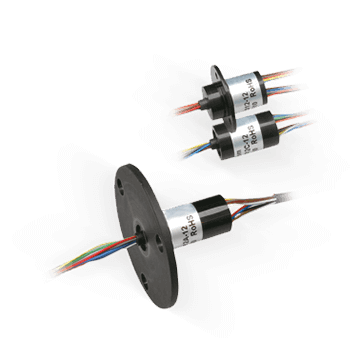
A slip ring, also known as a rotary electrical connector or collector ring, is an electromechanical component that provides a continuous electrical connection between a stationary part and a rotating part. It can transmit power, analog or digital signals, and data, including Ethernet and various communication buses, while allowing continuous 360° rotation. This prevents cable twisting and wear that would otherwise limit the movement of a rotating axis.
PES S.A. offers a wide range of Servotecnica industrial slip rings, from compact models to through-bore, pancake, open-frame, or heavy-duty versions for harsh environments. Depending on the application, different configurations can combine power circuits, sensitive signals, and data transmission while taking into account current, voltage, rotational speed, space constraints, shaft diameter, or protection rating requirements.
Our expertise goes beyond simply selecting a standard catalogue reference. PES can adapt the slip ring to its mechanical and electrical environment: circuit configuration, cable length and type, connectors, mechanical interfaces, flanges, or wiring preparation. Our wiring workshop can also supply pre-assembled solutions designed to simplify integration into the machine.
Slip rings are used wherever part of a machine needs to rotate while remaining powered and connected : robotics and industrial automation, packaging and labelling machines, rotary and indexing tables, test benches, medical and pharmaceutical equipment, vision systems and cameras, wind turbines and renewable energy systems, reels, marine equipment, and industrial installations exposed to harsh environments.
By combining the Servotecnica range, from a manufacturer specialised in motion control technologies, with PES expertise in selection, customisation, and wiring, we can provide a suitable solution for both standard machinery and applications requiring a specific configuration.

- 200 references in stock
- Shipping available within 2 to 3 days
- PES technical support
Which slip ring is right for your application?

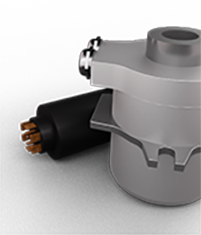

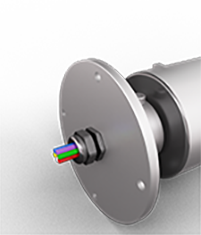

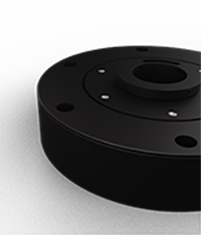
** Excluding discount
Not sure which slip ring to choose?
Tell us the number of circuits you need, the currents or signals to transmit, the rotation speed, and your mechanical constraints.
Our team will help you identify a standard model or a configuration tailored to your application.
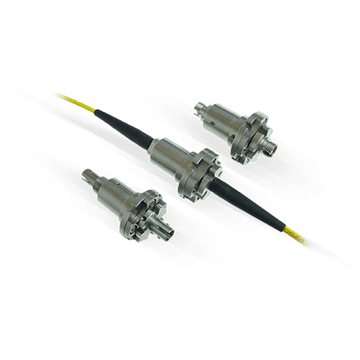
Not sure which technology best fits your application? Depending on your requirements, a hybrid slip ring solution can combine electrical power, signals and fluids, while a fiber optic rotary joint (FORJ) enables optical data transmission across a rotating interface.
To define the most suitable solution according to current, rotational speed, available space, data transmission or environmental constraints, you can also consult our guide: How to choose the right slip ring?
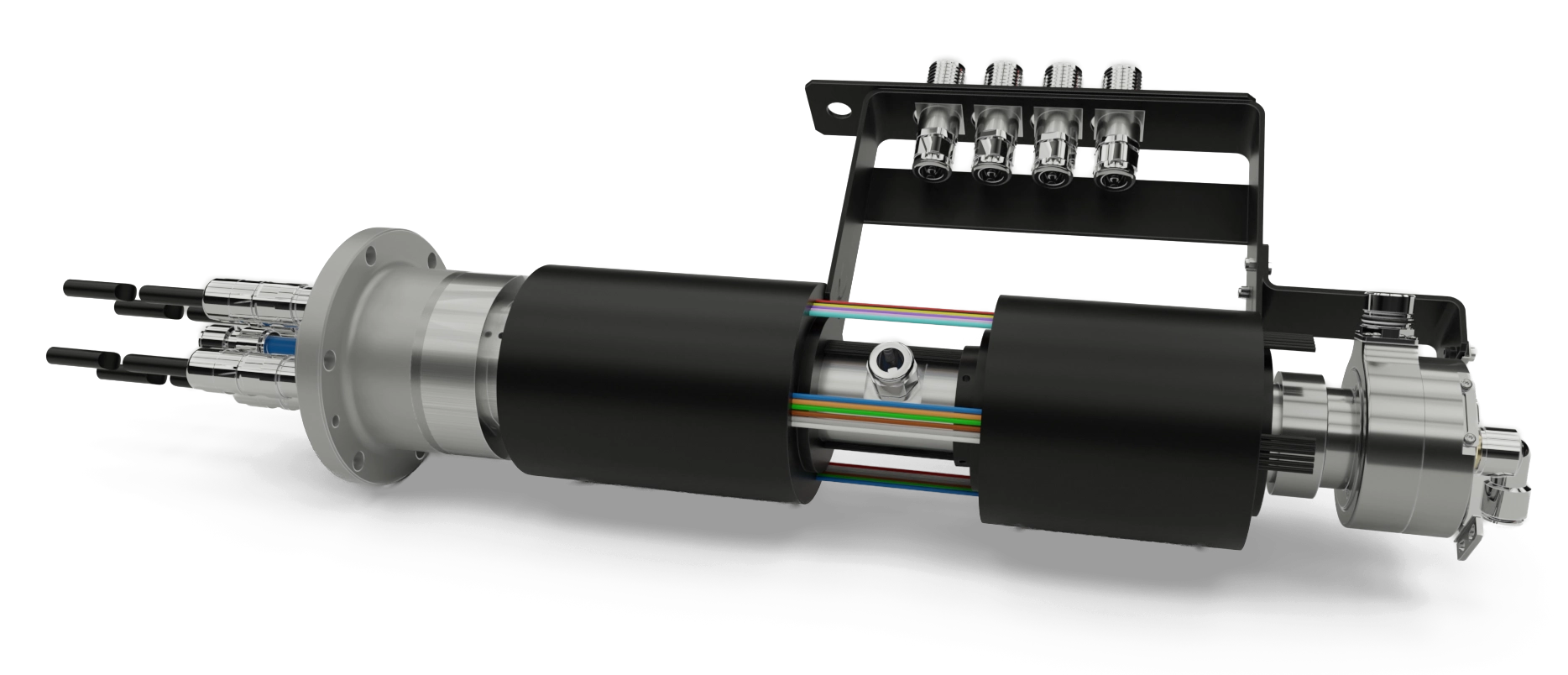
SVTS C 11-U-A-00/6060 circuits
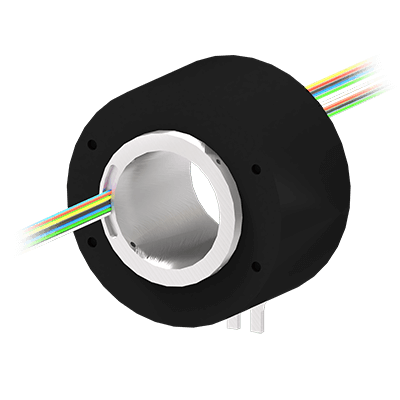
Maximum central clearance for large-axis rotating architectures
The SVTS C 11-U-A-00/60 is a through-bore slip ring with a 100 mm bore integrating 60 signal circuits rated at 5 A, with a 203 mm outer diameter and IP65 protection. It combines high signal transmission capacity with a large through-bore, suited to machines that must preserve substantial access through the centre of the axis.

>400 rpm
60 x 5A
IP65
203.0 mm
SVTS C 11-U-A-00/7272 circuits
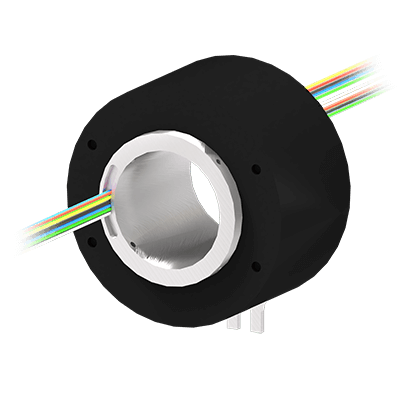
Maximum central clearance for large-axis rotating architectures
The SVTS C 11-U-A-00/72 is a through-bore slip ring with a 100 mm bore integrating 72 signal circuits rated at 5 A, with a 203 mm outer diameter and IP65 protection. Its 100 mm through-bore preserves a substantial central passage for the shaft, cable bundles or lines while grouping signal transmission in a single rotary interface.
>400 rpm
72 x 5A
IP65
203.0 mm
SVTS C 11-U-A-00/8484 circuits
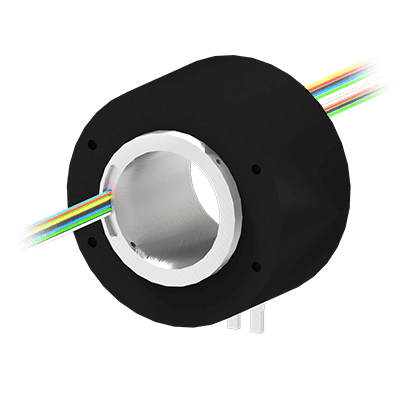
Maximum central clearance for large-axis rotating architectures
The SVTS C 11-U-A-00/84 is a through-bore slip ring with a 100 mm bore integrating 84 signal circuits rated at 5 A, with a 203 mm outer diameter and IP65 protection. This channel density centralises electrical signals around a 100 mm through-bore and limits the number of separate connections on the rotating axis.
>400 rpm
84 x 5A
IP65
203.0 mm
SVTS C 11-U-A-00/9696 circuits
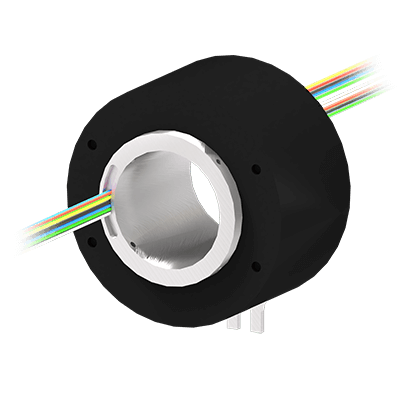
Maximum central clearance for large-axis rotating architectures
The SVTS C 11-U-A-00/96 is a through-bore slip ring with a 100 mm bore integrating 96 signal circuits rated at 5 A, with a 203 mm outer diameter and IP65 protection. The 100 mm central passage facilitates mechanical integration while signal connections are grouped into a single rotary interface.
>400 rpm
96 x 5A
IP65
203.0 mm
SVTS C 11-U-A-06/006 circuits
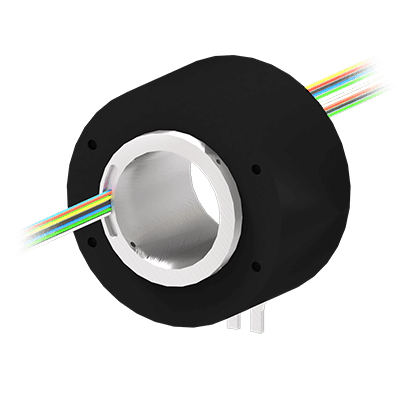
Maximum central clearance for large-axis rotating architectures
The SVTS C 11-U-A-06/00 is a through-bore slip ring with a 100 mm bore integrating 6 power circuits rated at 20 A, with a 203 mm outer diameter and IP65 protection. It centralises multiple power channels around the 100 mm through-bore to supply rotating functions without sacrificing the central mechanical space.
>400 rpm
6 x 20A
IP65
203.0 mm
SVTS C 11-U-A-06/1218 circuits
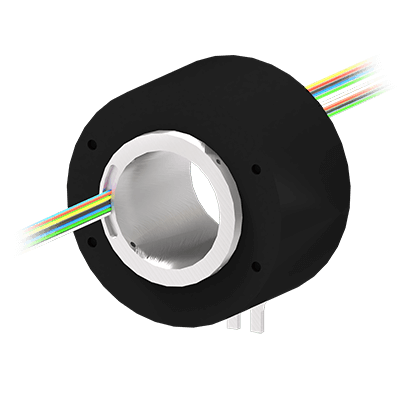
Maximum central clearance for large-axis rotating architectures
The SVTS C 11-U-A-06/12 is a through-bore slip ring with a 100 mm bore integrating 18 circuits in total, including 12 signal circuits rated at 5 A and 6 power circuits rated at 20 A, with a 203 mm outer diameter and IP65 protection. It centralises different current levels while preserving the large central mechanical passage required by the machine architecture.
>400 rpm
12 x 5A, 6 x 20A
IP65
203.0 mm
SVTS C 11-U-A-06/2430 circuits
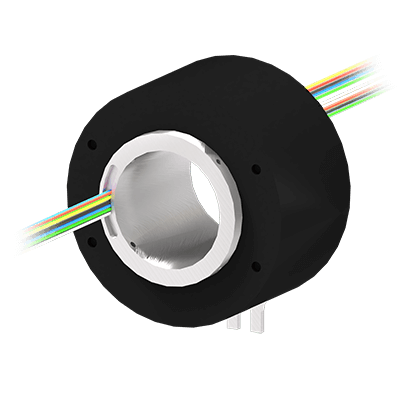
Maximum central clearance for large-axis rotating architectures
The SVTS C 11-U-A-06/24 is a through-bore slip ring with a 100 mm bore integrating 30 circuits in total, including 24 signal circuits rated at 5 A and 6 power circuits rated at 20 A, with a 203 mm outer diameter and IP65 protection. The slip ring groups signal and power circuits without sacrificing the space through the centre of the axis, limiting the number of separate rotary connections.
>400 rpm
24 x 5A, 6 x 20A
IP65
203.0 mm
SVTS C 11-U-A-06/3642 circuits
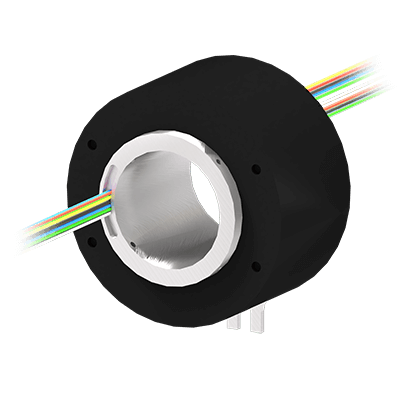
Maximum central clearance for large-axis rotating architectures
The SVTS C 11-U-A-06/36 is a through-bore slip ring with a 100 mm bore integrating 42 circuits in total, including 36 signal circuits rated at 5 A and 6 power circuits rated at 20 A, with a 203 mm outer diameter and IP65 protection. Its mixed configuration combines control and power transmission in a single rotary interface around a 100 mm through-bore.
>400 rpm
36 x 5A, 6 x 20A
IP65
203.0 mm
SVTS C 11-U-A-06/4854 circuits
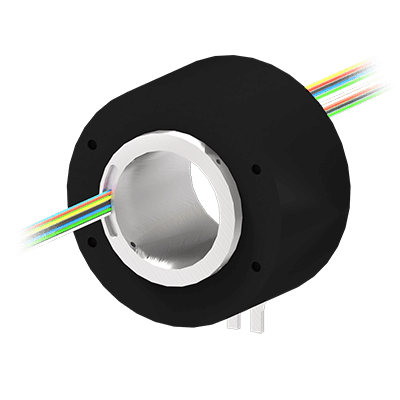
Maximum central clearance for large-axis rotating architectures
The SVTS C 11-U-A-06/48 is a through-bore slip ring with a 100 mm bore integrating 54 circuits in total, including 48 signal circuits rated at 5 A and 6 power circuits rated at 20 A, with a 203 mm outer diameter and IP65 protection. This configuration combines signals and power around the 100 mm through-bore, simplifying the wiring of a complex rotating axis in a single interface.
>400 rpm
48 x 5A, 6 x 20A
IP65
203.0 mm
SVTS C 11-U-A-06/6066 circuits
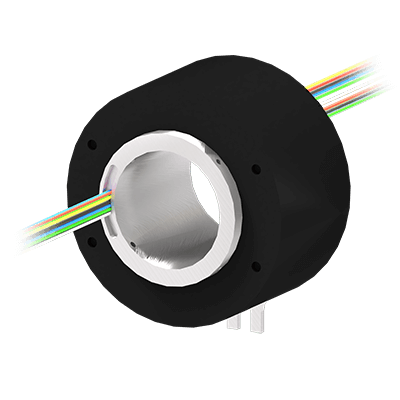
Maximum central clearance for large-axis rotating architectures
The SVTS C 11-U-A-06/60 is a through-bore slip ring with a 100 mm bore integrating 66 circuits in total, including 60 signal circuits rated at 5 A and 6 power circuits rated at 20 A, with a 203 mm outer diameter and IP65 protection. It centralises different current levels while preserving the large central mechanical passage required by the machine architecture.
>400 rpm
60 x 5A, 6 x 20A
IP65
203.0 mm
SVTS C 11-U-A-06/7278 circuits
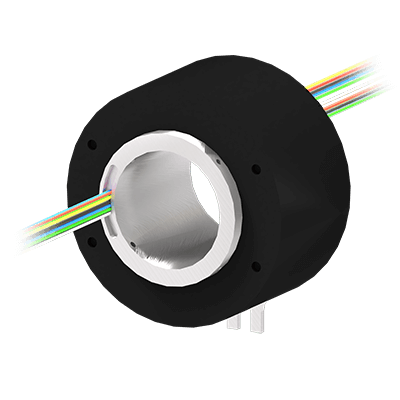
Maximum central clearance for large-axis rotating architectures
The SVTS C 11-U-A-06/72 is a through-bore slip ring with a 100 mm bore integrating 78 circuits in total, including 72 signal circuits rated at 5 A and 6 power circuits rated at 20 A, with a 203 mm outer diameter and IP65 protection. The slip ring groups signal and power circuits without sacrificing the space through the centre of the axis, limiting the number of separate rotary connections.
>400 rpm
72 x 5A, 6 x 20A
IP65
203.0 mm
SVTS C 11-U-A-06/8490 circuits
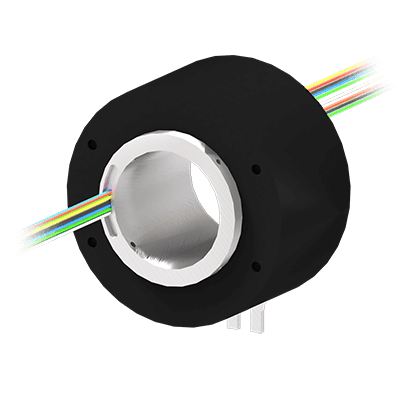
Maximum central clearance for large-axis rotating architectures
The SVTS C 11-U-A-06/84 is a through-bore slip ring with a 100 mm bore integrating 90 circuits in total, including 84 signal circuits rated at 5 A and 6 power circuits rated at 20 A, with a 203 mm outer diameter and IP65 protection. Its mixed configuration combines control and power transmission in a single rotary interface around a 100 mm through-bore.
>400 rpm
84 x 5A, 6 x 20A
IP65
203.0 mm
SVTS C 11-U-A-12/0012 circuits
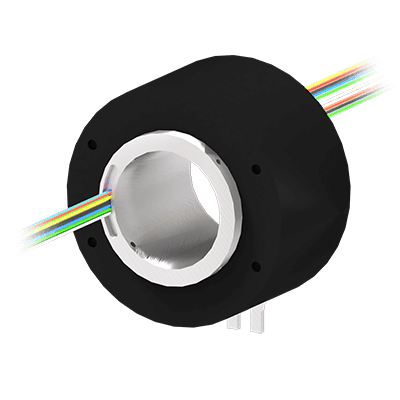
Maximum central clearance for large-axis rotating architectures
The SVTS C 11-U-A-12/00 is a through-bore slip ring with a 100 mm bore integrating 12 power circuits rated at 20 A, with a 203 mm outer diameter and IP65 protection. It centralises multiple power channels around the 100 mm through-bore to supply rotating functions without sacrificing the central mechanical space.
>400 rpm
12 x 20A
IP65
203.0 mm
SVTS C 11-U-A-12/1224 circuits
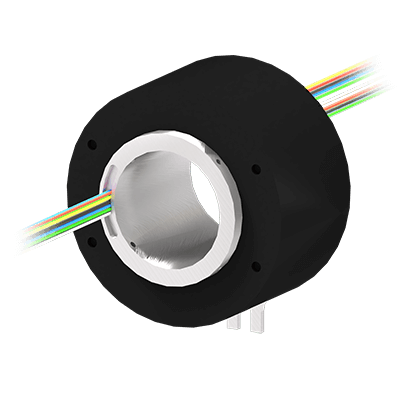
Maximum central clearance for large-axis rotating architectures
The SVTS C 11-U-A-12/12 is a through-bore slip ring with a 100 mm bore integrating 24 circuits in total, including 12 signal circuits rated at 5 A and 12 power circuits rated at 20 A, with a 203 mm outer diameter and IP65 protection. It centralises different current levels while preserving the large central mechanical passage required by the machine architecture.
>400 rpm
12 x 5A, 12 x 20A
IP65
203.0 mm
SVTS C 11-U-A-12/2436 circuits
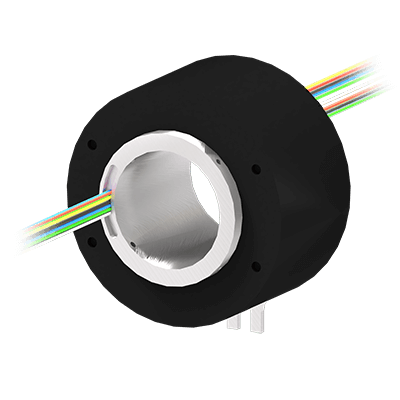
Maximum central clearance for large-axis rotating architectures
The SVTS C 11-U-A-12/24 is a through-bore slip ring with a 100 mm bore integrating 36 circuits in total, including 24 signal circuits rated at 5 A and 12 power circuits rated at 20 A, with a 203 mm outer diameter and IP65 protection. The slip ring groups signal and power circuits without sacrificing the space through the centre of the axis, limiting the number of separate rotary connections.
>400 rpm
24 x 5A, 12 x 20A
IP65
203.0 mm
SVTS C 11-U-A-12/3648 circuits
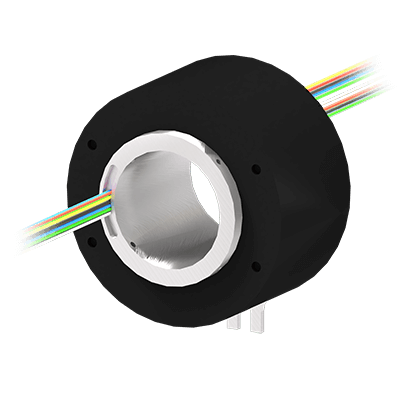
Maximum central clearance for large-axis rotating architectures
The SVTS C 11-U-A-12/36 is a through-bore slip ring with a 100 mm bore integrating 48 circuits in total, including 36 signal circuits rated at 5 A and 12 power circuits rated at 20 A, with a 203 mm outer diameter and IP65 protection. Its mixed configuration combines control and power transmission in a single rotary interface around a 100 mm through-bore.
>400 rpm
36 x 5A, 12 x 20A
IP65
203.0 mm
SVTS C 11-U-A-12/4860 circuits
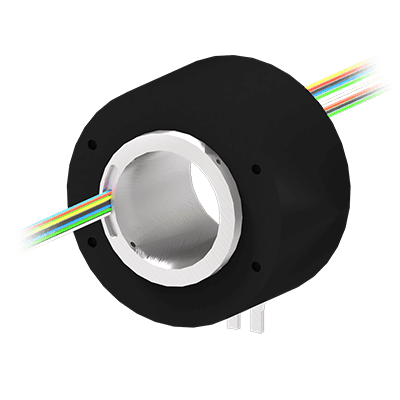
Maximum central clearance for large-axis rotating architectures
The SVTS C 11-U-A-12/48 is a through-bore slip ring with a 100 mm bore integrating 60 circuits in total, including 48 signal circuits rated at 5 A and 12 power circuits rated at 20 A, with a 203 mm outer diameter and IP65 protection. This configuration combines signals and power around the 100 mm through-bore, simplifying the wiring of a complex rotating axis in a single interface.
>400 rpm
48 x 5A, 12 x 20A
IP65
203.0 mm
SVTS C 11-U-A-12/6072 circuits
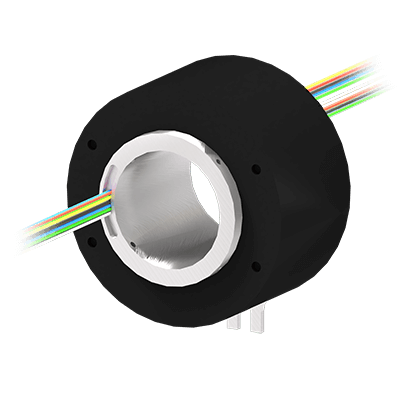
Maximum central clearance for large-axis rotating architectures
The SVTS C 11-U-A-12/60 is a through-bore slip ring with a 100 mm bore integrating 72 circuits in total, including 60 signal circuits rated at 5 A and 12 power circuits rated at 20 A, with a 203 mm outer diameter and IP65 protection. It centralises different current levels while preserving the large central mechanical passage required by the machine architecture.
>400 rpm
60 x 5A, 12 x 20A
IP65
203.0 mm
SVTS C 11-U-A-12/7284 circuits
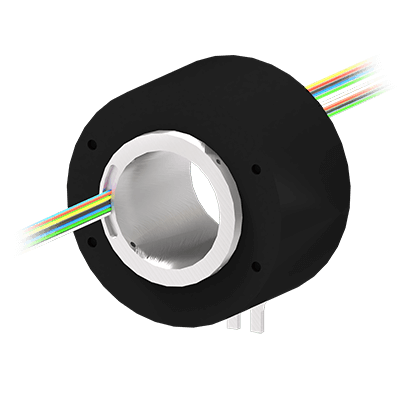
Maximum central clearance for large-axis rotating architectures
The SVTS C 11-U-A-12/72 is a through-bore slip ring with a 100 mm bore integrating 84 circuits in total, including 72 signal circuits rated at 5 A and 12 power circuits rated at 20 A, with a 203 mm outer diameter and IP65 protection. The slip ring groups signal and power circuits without sacrificing the space through the centre of the axis, limiting the number of separate rotary connections.
>400 rpm
72 x 5A, 12 x 20A
IP65
203.0 mm
SVTS C 11-U-A-18/0018 circuits
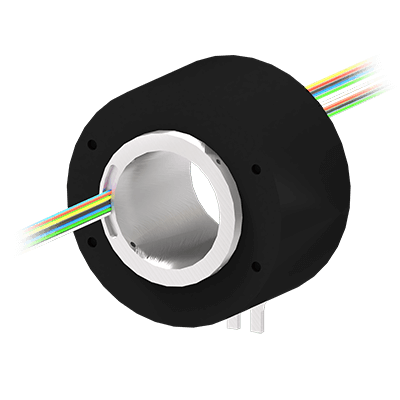
Maximum central clearance for large-axis rotating architectures
The SVTS C 11-U-A-18/00 is a through-bore slip ring with a 100 mm bore integrating 18 power circuits rated at 20 A, with a 203 mm outer diameter and IP65 protection. This architecture simplifies power distribution to the rotating section while preserving a particularly large central passage.
>400 rpm
18 x 20A
IP65
203.0 mm
SVTS C 11-U-A-18/1230 circuits
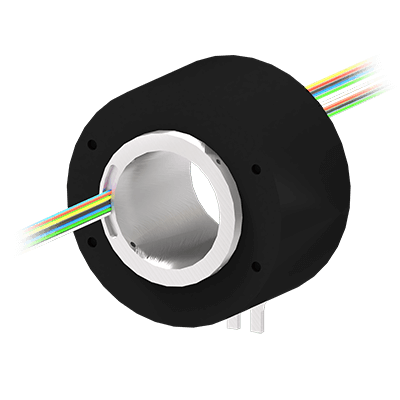
Maximum central clearance for large-axis rotating architectures
The SVTS C 11-U-A-18/12 is a through-bore slip ring with a 100 mm bore integrating 30 circuits in total, including 12 signal circuits rated at 5 A and 18 power circuits rated at 20 A, with a 203 mm outer diameter and IP65 protection. This configuration combines signals and power around the 100 mm through-bore, simplifying the wiring of a complex rotating axis in a single interface.
>400 rpm
12 x 5A, 18 x 20A
IP65
203.0 mm
SVTS C 11-U-A-18/2442 circuits
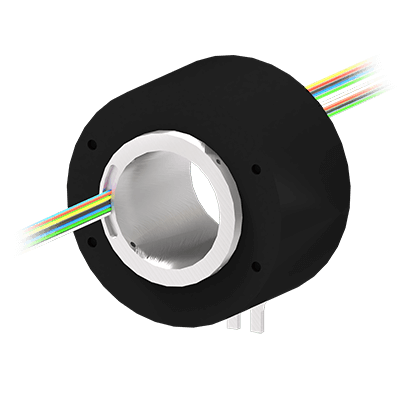
Maximum central clearance for large-axis rotating architectures
The SVTS C 11-U-A-18/24 is a through-bore slip ring with a 100 mm bore integrating 42 circuits in total, including 24 signal circuits rated at 5 A and 18 power circuits rated at 20 A, with a 203 mm outer diameter and IP65 protection. It centralises different current levels while preserving the large central mechanical passage required by the machine architecture.
>400 rpm
24 x 5A, 18 x 20A
IP65
203.0 mm
SVTS C 11-U-A-18/3654 circuits
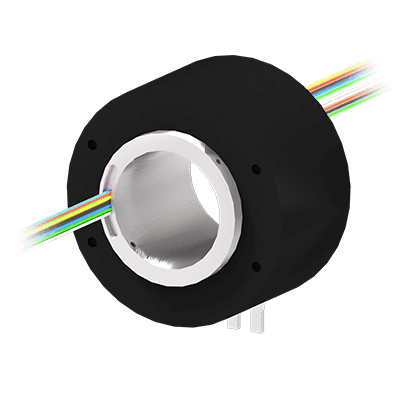
Maximum central clearance for large-axis rotating architectures
The SVTS C 11-U-A-18/36 is a through-bore slip ring with a 100 mm bore integrating 54 circuits in total, including 36 signal circuits rated at 5 A and 18 power circuits rated at 20 A, with a 203 mm outer diameter and IP65 protection. The slip ring groups signal and power circuits without sacrificing the space through the centre of the axis, limiting the number of separate rotary connections.
>400 rpm
36 x 5A, 18 x 20A
IP65
203.0 mm
SVTS C 11-U-A-18/4866 circuits
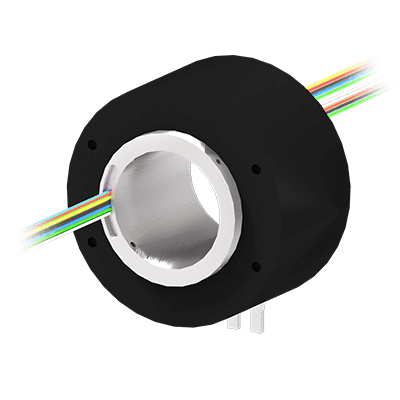
Maximum central clearance for large-axis rotating architectures
The SVTS C 11-U-A-18/48 is a through-bore slip ring with a 100 mm bore integrating 66 circuits in total, including 48 signal circuits rated at 5 A and 18 power circuits rated at 20 A, with a 203 mm outer diameter and IP65 protection. Its mixed configuration combines control and power transmission in a single rotary interface around a 100 mm through-bore.
>400 rpm
48 x 5A, 18 x 20A
IP65
203.0 mm
SVTS C 11-U-A-18/6078 circuits
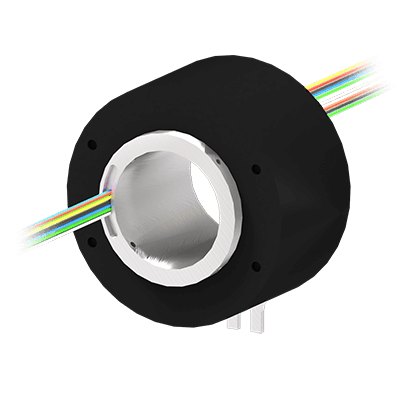
Maximum central clearance for large-axis rotating architectures
The SVTS C 11-U-A-18/60 is a through-bore slip ring with a 100 mm bore integrating 78 circuits in total, including 60 signal circuits rated at 5 A and 18 power circuits rated at 20 A, with a 203 mm outer diameter and IP65 protection. This configuration combines signals and power around the 100 mm through-bore, simplifying the wiring of a complex rotating axis in a single interface.
>400 rpm
60 x 5A, 18 x 20A
IP65
203.0 mm
SVTS C 11-U-A-24/0024 circuits
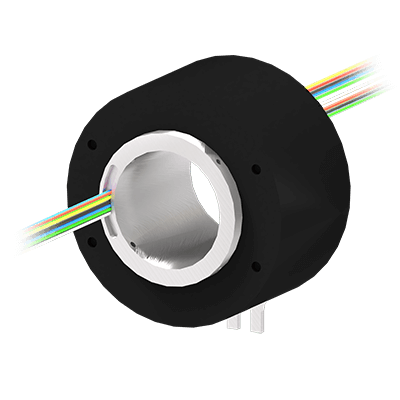
Maximum central clearance for large-axis rotating architectures
The SVTS C 11-U-A-24/00 is a through-bore slip ring with a 100 mm bore integrating 24 power circuits rated at 20 A, with a 203 mm outer diameter and IP65 protection. Its current capacity distributes power through the rotating axis while preserving a large central passage for the machine architecture.
>400 rpm
24 x 20A
IP65
203.0 mm
SVTS C 11-U-A-24/1236 circuits
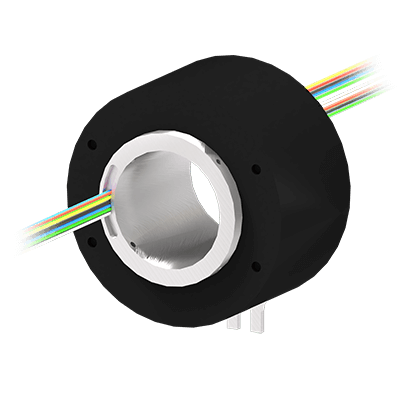
Maximum central clearance for large-axis rotating architectures
The SVTS C 11-U-A-24/12 is a through-bore slip ring with a 100 mm bore integrating 36 circuits in total, including 12 signal circuits rated at 5 A and 24 power circuits rated at 20 A, with a 203 mm outer diameter and IP65 protection. The slip ring groups signal and power circuits without sacrificing the space through the centre of the axis, limiting the number of separate rotary connections.
>400 rpm
12 x 5A, 24 x 20A
IP65
203.0 mm
SVTS C 11-U-A-24/2448 circuits
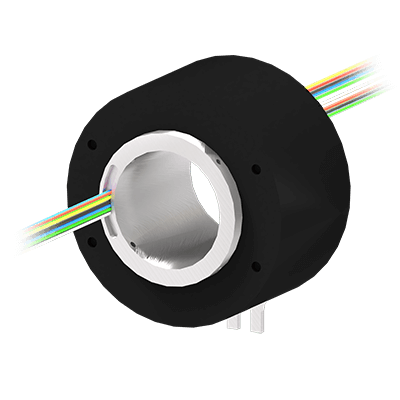
Maximum central clearance for large-axis rotating architectures
The SVTS C 11-U-A-24/24 is a through-bore slip ring with a 100 mm bore integrating 48 circuits in total, including 24 signal circuits rated at 5 A and 24 power circuits rated at 20 A, with a 203 mm outer diameter and IP65 protection. Its mixed configuration combines control and power transmission in a single rotary interface around a 100 mm through-bore.
>400 rpm
24 x 5A, 24 x 20A
IP65
203.0 mm
SVTS C 11-U-A-24/3660 circuits
Maximum central clearance for large-axis rotating architectures
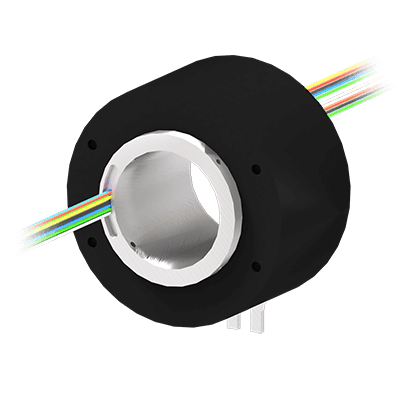
The SVTS C 11-U-A-24/36 is a through-bore slip ring with a 100 mm bore integrating 60 circuits in total, including 36 signal circuits rated at 5 A and 24 power circuits rated at 20 A, with a 203 mm outer diameter and IP65 protection. This configuration combines signals and power around the 100 mm through-bore, simplifying the wiring of a complex rotating axis in a single interface.
>400 rpm
36 x 5A, 24 x 20A
IP65
203.0 mm
SVTS C 11-U-A-24/4872 circuits
Maximum central clearance for large-axis rotating architectures
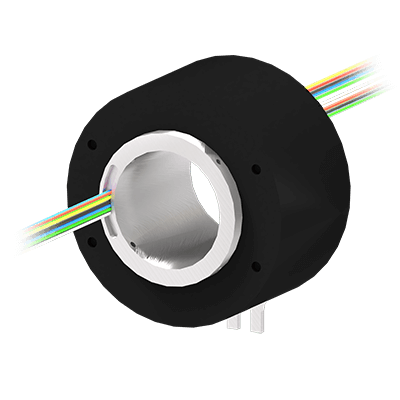
The SVTS C 11-U-A-24/48 is a through-bore slip ring with a 100 mm bore integrating 72 circuits in total, including 48 signal circuits rated at 5 A and 24 power circuits rated at 20 A, with a 203 mm outer diameter and IP65 protection. It centralises different current levels while preserving the large central mechanical passage required by the machine architecture.
>400 rpm
48 x 5A, 24 x 20A
IP65
203.0 mm
Our slip ring FAQ +
What is an electrical slip ring?
An electrical slip ring, also known as a collector ring, transmits electrical power, signals, or data between a stationary part and a rotating part, while allowing continuous 360° rotation without twisting the cables.
How does a slip ring work?
A slip ring maintains an electrical connection between a stationary stator and a rotating rotor. Conductive rings and contacts remain electrically connected during rotation, allowing power, signals or data to pass through the rotating interface without winding up the cables.
What is the difference between a slip ring, a rotary union and a rotary joint?
A slip ring transfers electrical power, signals or data through a rotating interface. A rotary union or rotary joint is generally used to transfer fluids such as air, water, oil, hydraulic fluid or vacuum. Both technologies can be combined in a hybrid rotary solution when electrical and fluid connections are required simultaneously.
How do I choose the right slip ring?
The correct slip ring depends on the number of circuits, current and voltage, signal or communication type, rotational speed, available space, mounting method and environmental conditions. Applications requiring a central shaft, for example, will usually require a through-bore slip ring.
What information is required to select or size a slip ring?
The main information required includes the number of circuits, current and voltage per circuit, signal or communication protocol, rotational speed, duty cycle, available dimensions, required through-bore diameter and environmental protection. Temperature, vibration, humidity and special connectors may also affect the selection.
What is a through-bore slip ring?
A through-bore slip ring has a central opening that allows a shaft, tube, cable or other mechanical element to pass through the centre of the rotating connection. It is commonly used on rotating shafts, indexing tables, machine tools and automation equipment.
Can a slip ring transmit Ethernet, EtherCAT or PROFINET?
Yes. Suitable slip ring configurations can transmit Ethernet and industrial communication protocols such as EtherCAT or PROFINET. The slip ring must be selected according to the protocol, data rate, shielding, impedance, cable type and the other electrical circuits sharing the assembly.
Can power and signals be transmitted through the same slip ring?
Yes. A single slip ring can combine power circuits with analogue, digital or communication signals. Proper circuit separation, shielding, grounding and EMC design are important when power and sensitive signals are transmitted through the same rotating assembly.
What IP protection rating should a slip ring have?
The required IP rating depends on the operating environment. Dust, water spray, humidity, condensation and contaminants must be considered when selecting the enclosure and sealing level. Higher-protection slip rings are available for demanding industrial environments.
What is the typical lifetime of a slip ring?
Slip ring lifetime depends on the design, rotational speed, operating cycle, electrical load and environmental conditions. Depending on the model and application, industrial slip rings can achieve many millions of revolutions before service or replacement is required.
Do slip rings require maintenance?
Many modern industrial slip rings are designed for very low maintenance or maintenance-free operation during their expected service life. Maintenance requirements nevertheless depend on the contact technology, rotational speed, duty cycle and operating environment.
Can electrical, pneumatic, hydraulic and vacuum connections be combined?
Yes. Hybrid rotary assemblies can combine electrical power, signals or data with pneumatic, hydraulic, water, oil or vacuum passages. These solutions are useful when several types of energy or media must cross the same rotating interface.
Can a slip ring be combined with a fibre optic rotary joint?
Yes. A slip ring can be integrated with a FORJ, or Fiber Optic Rotary Joint, to transmit electrical power and signals together with optical data through the same rotating system. The number of fibres and mechanical configuration depend on the application.
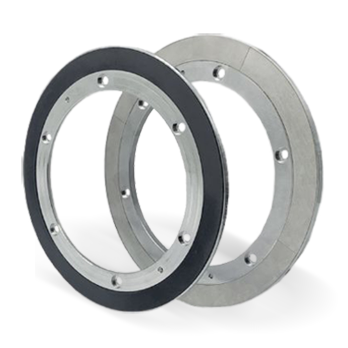
Are flat or pancake slip rings available?
Yes. Flat or pancake slip rings are designed for applications where axial height is limited. Their larger diameter and reduced height make them suitable for rotating systems where a conventional cylindrical slip ring cannot easily be integrated.
Can an existing slip ring from another manufacturer be replaced?
Yes. An existing slip ring can often be replaced by analysing its electrical, mechanical and environmental specifications. The existing reference, datasheet, dimensions, wiring information or drawings can be used to identify an equivalent solution or develop an adapted configuration.
Can slip rings be supplied with customised cables and connectors?
Yes. Depending on the application, slip rings can be supplied with specific cable lengths, connectors, wiring arrangements or mechanical interfaces. This can simplify machine integration and reduce additional wiring work during installation.
What are the delivery times for industrial slip rings?
Delivery time depends on the selected model, configuration and availability. Standard references held in stock can generally be supplied much faster than customised or application-specific assemblies, which may require additional engineering and production time.
Which certifications are available for industrial slip rings?
Certification depends on the slip ring model and the target application. CE conformity and other certifications or approvals may be available depending on the configuration, market and technical requirements. Certification requirements should therefore be confirmed during product selection.
Are UL-compliant slip rings available?
Yes. UL-compliant slip ring configurations can be available depending on the model, application and required materials or components. Because UL requirements can vary with the target market and equipment category, compliance should be confirmed for the selected configuration during the technical review.
What is the maximum rotational speed of a slip ring?
The maximum rotational speed of a slip ring depends on its design, dimensions, contact technology and operating conditions. Some industrial slip rings operate at a few hundred revolutions per minute, while specific configurations can support higher speeds. Rotational speed must always be checked for the selected model because it directly affects wear and service life.
Can a slip ring transmit HD video, GigE Vision, HDMI or HD-SDI?
Yes. Suitable slip rings can transmit high-definition video and high-speed imaging signals, including Gigabit Ethernet/GigE Vision, HD-SDI or dedicated coaxial connections. The correct configuration depends on data rate, frequency, impedance, shielding, cable type and the other electrical circuits integrated into the slip ring.
What temperature range can a slip ring operate in?
The operating temperature range depends on the slip ring model, materials, bearings, cables and environmental conditions. Standard industrial slip rings are available for a wide range of temperatures, while specific versions can be designed for more demanding thermal environments. Temperature requirements should therefore be defined during the selection process.
When should I choose a standard or custom slip ring?
A standard slip ring is usually the best choice when an existing model already meets the electrical, mechanical, dimensional and environmental requirements of the application. A customised solution becomes relevant when specific connectors, unusual dimensions, sensitive signals, high-frequency transmission, harsh environments or combined electrical and fluid connections are required.
Can a slip ring transmit RF or coaxial signals?
Yes. Slip rings can be designed to transmit RF or coaxial signals in applications such as radar systems, antennas, video equipment, instrumentation and high-frequency communication. The selected solution must take into account frequency range, impedance, insertion loss, shielding and the mechanical constraints of the rotating system.
Ask your question